


During hot Texas summers, temperatures inside an unvented attic can easily surpass 150°F. This trapped heat acts as a massive thermal battery, radiating downward into your living spaces and forcing your air conditioner to run continuously. Partnering with a qualified attic ventilation roofer in Missouri City to optimize your home’s airflow is one of the most effective ways to slash cooling costs and protect your roof deck.
Here is a breakdown of why attic airflow matters and how to choose between the top two ventilation systems: ridge vents and solar attic fans.
1. Why Proper Attic Ventilation is Essential in Texas
A well-designed attic ventilation system creates a continuous loop, drawing cooler air in through soffit vents at the eaves and exhausting superheated air out through the top of the roof.
- Protects Shingles from Thermal Damage: Extreme heat trapped beneath the roof deck can bake shingles from the inside out, causing premature blistering, curling, and granule loss.
- Reduces Air Conditioning Demand: By keeping attic temperatures closer to ambient outdoor levels, you minimize heat transfer through ceiling insulation into your living quarters.
- Controls Moisture and Mold: Adequate airflow prevents humidity buildup, protecting roof decking and wooden trusses from moisture rot and mold growth.
Roof Life, Questions, and Types: Everything Texas Homeowners Should Know
2. Ridge Vents: Passive, Continuous Exhaust
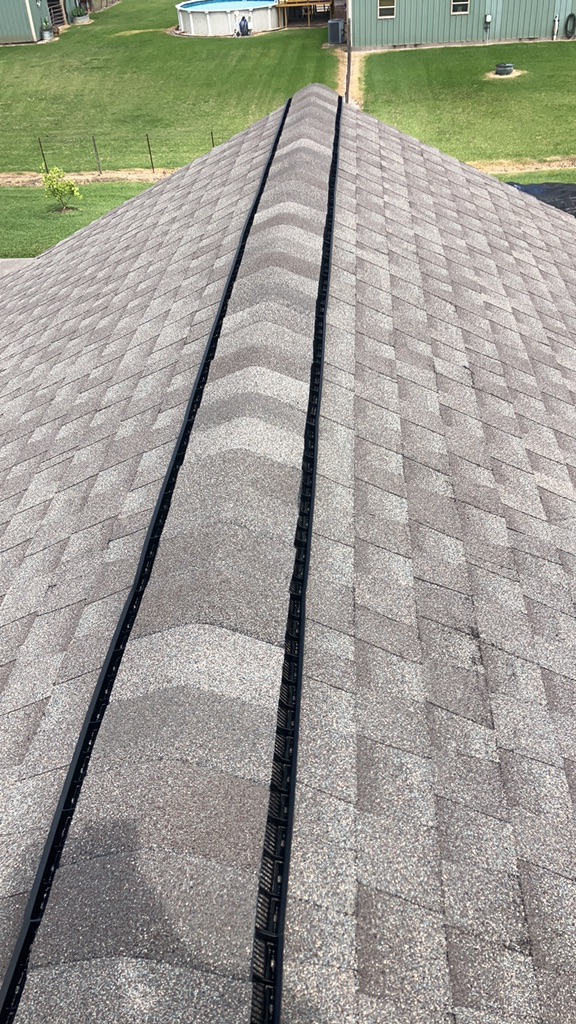
Ridge vents run continuously along the highest peak of your roof, providing a subtle, low-profile exit route for rising hot air.
- How They Work: Operating on the natural principle of thermal convection, warm air naturally rises and escapes through the ridge, drawing fresh air up through the soffit vents underneath.
- Key Advantages:
- Zero Moving Parts: Purely mechanical-free operation means no motors to replace or electrical wiring to maintain.
- Seamless Appearance: Blends directly into your shingle peak for a sleek, clean roofline.
- Uniform Air Flow: Distributes exhaust evenly across the entire length of the roof ridge.
3. Solar Attic Fans: Active, High-Power Extraction
Solar attic fans rely on top-mounted photovoltaic panels to power a heavy-duty electric fan, actively pulling hot air out of your attic.
- How They Work: As the morning sun hits the panel, the fan automatically kicks on—reaching peak extraction speed during the hottest midday hours when solar radiation is strongest.
- Key Advantages:
- High CFM Performance: Moves large volumes of trapped hot air quickly out of complex or hard-to-ventilate spaces.
- No Electrical Cost: Powered 100% by sunlight, operating without adding a penny to your grid electricity bill.
- Targeted Heat Release: Ideal for homes with complex hip roofs or shorter ridge lines that lack adequate length for continuous ridge venting.
4. Ridge Vents vs. Solar Attic Fans: Choosing the Right Fit
Both ridge vents and solar attic fans effectively lower attic temperatures, but they operate differently and suit different roof structures.
Ridge Vents
- Air Movement: Passive convection. Hot air naturally rises and escapes through the roof peak.
- Appearance: Virtually invisible. Blends seamlessly along the peak of your shingle line.
- Best Suited For: Homes with long, open, continuous roof ridges.
- Power Source: None. Relies purely on natural physics.
- Maintenance: Zero moving parts, requiring virtually no ongoing maintenance.
Solar Attic Fans
- Air Movement: Active extraction. Motorized fan blades actively pull hot air out of the attic space.
- Appearance: A sleek, low-profile dome mounted on the roof slope.
- Best Suited For: Complex roof layouts, hip roofs, or short ridge lines that lack long continuous peaks.
- Power Source: 100% solar-powered. Operates at peak performance during the sunniest, hottest parts of the day.
- Maintenance: Minimal periodic checks to clean solar panel surfaces and ensure smooth motor operation.
An experienced attic ventilation roofer in Missouri City will evaluate your attic’s square footage, soffit intake balance, and roof design to recommend the perfect combination of ventilation tools to keep your house cool and energy bills low all summer long.
Helpful links:
5 Practical Solutions for Roof Repair in Texas Homes
Is it time to check your roof?
At Ernie Smith & Sons Roofing, we’re proud to serve Southeast Texas homeowners with a focus on dependable service, quality workmanship, and long-term roof care. Whether you need a roof inspection, help evaluating tree-related shingle damage, or assistance with a roof repair, our team can help you understand your options.
Contact Ernie Smith & Sons Roofing today to schedule a roof inspection and learn more about maintaining your roof through Southeast Texas.
Ernie Smith & Sons Roofing, LLC
Trusted. Local. Since 1989.
Proudly Serving Southeast Texas
Schedule Your Free Roof Inspection
Or Call Us: (832) 336 5153
